| Welding Category | Core Principle | Advantages | Disadvantages | Key Technical Parameters | Standard Reference (GB/T, National Standard) | Quality Evaluation Indicators | Application Scenarios |
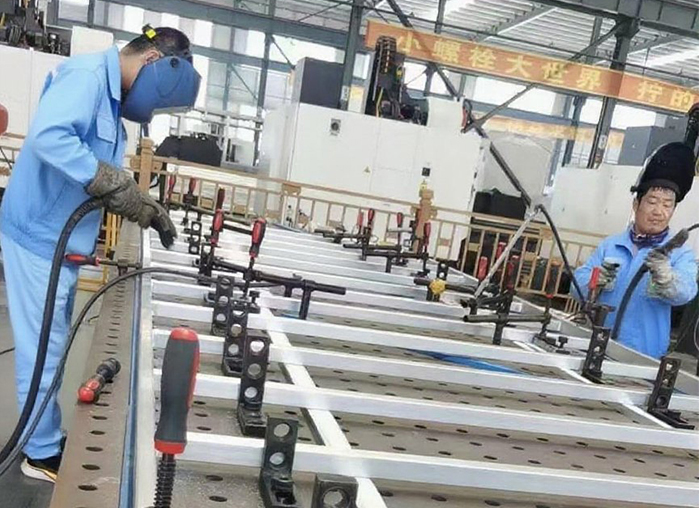
| Arc Welding (Manual/Semi-automatic) | Uses the arc heat generated between the electrode and the base metal to melt the base metal and filler metal (welding wire/welding rod), forming a welded joint after cooling. | 1. Wide application range (suitable for various metals, thickness: 5-50mm); 2. Low equipment cost and flexible operation; 3. Applicable for field operations. | 1. Large welding deformation, requiring subsequent correction; 2. Weld quality depends on the operator's skills; 3. Low efficiency, prone to pores/incomplete penetration. | 1. Welding current (80-500A); 2. Arc voltage (18-40V); 3. Welding speed (5-30cm/min); 4. Diameter of welding rod/wire (1.6-5.0mm). | GB/T 985-2008 (Grooves for Gas Welding and Arc Welding), GB/T 14957-1994 (Welding Wires) | 1. Appearance: No cracks, pores, or undercutting (depth ≤ 0.5mm); 2. Non-Destructive Testing (NDT): UT/RT qualification rate ≥ 98%; 3. Mechanical properties: Tensile strength ≥ 85% of base metal, no cracks in bending test. | 1. Large hardware structural parts (e.g., steel shelves, mechanical frames); 2. Thick-walled pipe welding (e.g., hardware pipe connectors); 3. Field emergency repair (e.g., repair of agricultural machinery hardware components). |
| Resistance Welding (Spot/Seam Welding) | After workpieces are in contact, pressure is applied, and a large current is passed to generate heat via contact resistance, melting local base metal and forming spot welds/seam welds after cooling. | 1. High efficiency (single spot welding time < 1s); 2. No filler material, small welding deformation; 3. Strong adaptability to automation. | 1. Limited applicable thickness (usually ≤ 3mm, mostly for thin-plate hardware); 2. Low joint strength (unable to bear large tensile force); 3. Requires base metal with good electrical conductivity. | 1. Welding current (1-100kA); 2. Electrode pressure (0.5-5kN); 3. Current-on time (5-500ms); 4. Electrode diameter (5-20mm). | GB/T 15579-2018 (Resistance Welding Equipment), GB/T 16855.1-2018 (Spot Weld Joints) | 1. Spot weld diameter: ≥ 1.5 times the plate thickness (minimum ≥ 3mm); 2. Tensile shear strength: Meets product design requirements (e.g., ≥ 150N/mm² for spot welding of cold-rolled steel plates); 3. No false welding or burn-through. | 1. Assembly of thin-plate hardware (e.g., iron file cabinets, metal distribution box casings); 2. Automotive hardware accessories (e.g., door hinges, seat metal brackets); 3. Wire mesh hardware products (e.g., spot welding connection of protective nets). |
| Oxy-Acetylene Welding (Gas Welding) | Uses high-temperature flame (approximately 3100℃) generated by the mixed combustion of acetylene and oxygen to melt the base metal and welding wire, forming a welded joint. | 1. Portable equipment and extremely low cost; 2. Applicable for welding thin and small parts (thickness: 1-3mm); 3. Usable for repair welding and brazing. | 1. Low flame temperature and slow heating speed (low efficiency); 2. Large heat-affected zone and severe deformation; 3. Low safety (flammable and explosive). | 1. Oxy-acetylene mixture ratio (neutral flame: 1:1.2, oxidizing flame: 1:1.5); 2. Flame power (0.5-5kW); 3. Welding speed (3-8cm/min). | GB/T 986-2012 (Symbols for Gas Welding and Arc Welding Seams), GB/T 34526-2017 (Gas Welding Equipment) | 1. Appearance: Flat weld, no burn-through or cracks; 2. Sealing performance: No leakage in air pressure test (for sealed hardware); 3. Hardness: Hardness fluctuation in heat-affected zone ≤ 20% of base metal. | 1. Repair welding of small hardware parts (e.g., tool edges, repair of small-sized bolts); 2. Thin copper pipe welding (e.g., hardware plumbing accessories); 3. Simple hardware processing (e.g., hand-made metal crafts). |
| Brazing (Soft/Hard Brazing) | Heat to the melting point of the brazing filler metal (lower than the melting point of the base metal); the brazing filler metal melts, wets the base metal surface, fills the gap, and forms a joint after cooling. | 1. Minimal welding deformation (low heat input); 2. Applicable for welding precision and complex hardware (e.g., gears, bearings); 3. No damage to base metal performance. | 1. Low joint strength (soft brazing: ≤ 100MPa, hard brazing: ≤ 300MPa); 2. Strict requirement for base metal surface cleaning (oil, oxide layer); 3. Not suitable for high-temperature working conditions. | 1. Brazing temperature (soft brazing: 180-450℃, hard brazing: > 450℃); 2. Holding time (5-60min); 3. Brazing filler metal gap (0.05-0.2mm). | GB/T 11364-2008 (Brazing Process Specification), GB/T 6418-1993 (Brazing Filler Metal Types) | 1. Joint filling rate: ≥ 95% (no unfilled areas); 2. Shear strength: Meets the requirements of GB/T 11363; 3. Appearance: No brazing filler metal run-off or base metal oxidation. | 1. Precision hardware components (e.g., clock gears, micro-motor casings); 2. Dissimilar metal connection (e.g., copper-steel hardware joints); 3. Sealed hardware parts (e.g., valve cores, sensor metal casings). |
| Laser Welding (Fiber Laser Welding) | Uses a high-energy-density laser beam (10⁶-10⁸W/cm²) to melt the base metal, achieving rapid welding (with no/little filler material). | 1. Extremely small heat-affected zone (≤ 0.1mm) and negligible deformation; 2. High welding precision (weld width: 0.1-1mm); 3. High degree of automation. | 1. High equipment cost (single unit: 100,000-500,000 RMB); 2. Strict requirements for base metal assembly gap (≤ 0.1mm); 3. Multi-layer welding required for thick-plate welding. | 1. Laser power (500-6000W); 2. Focused spot diameter (0.1-0.5mm); 3. Welding speed (10-100cm/min); 4. Defocus amount (-2-+2mm). | GB/T 30564-2014 (Laser Welding Process Specification), GB/T 38813-2020 (Laser Welding Equipment) | 1. Weld size: Width/depth ratio meets design requirements (usually 1:3-1:5); 2. NDT: No surface defects in MT/PT; 3. Fatigue performance: No fracture after 10⁷ cycles. | 1. High-precision hardware products (e.g., mobile phone metal middle frames, laptop hardware brackets); 2. Thin-walled stainless steel parts (e.g., medical device hardware accessories, food-grade pipes); 3. Mass automated production (e.g., welding of new energy vehicle battery tabs). |